GPT-5.6 Just Killed the Office as We Know It — ChatGPT Work, Local File Access, and the AI That Runs Your Computer
Three Models, Three Missions: Sol, Terra, and Luna
Before we get into the office revolution, let's make sure we understand the three-model strategy that makes it all work. OpenAI didn't just release one model with GPT-5.6 — they released an ecosystem, and each model has a very specific job.
| Model | Mission | Best For | Cost Relative to Sol |
|---|---|---|---|
| Sol (Flagship) | Deep reasoning, complex coding, creative work | Architecture decisions, security analysis, novel problem-solving | 1x (baseline) |
| Terra (Office) | Productivity, document processing, routine analysis | Email, reports, spreadsheets, presentations, scheduling | ~0.3x |
| Luna (High-Volume) | Massive throughput, batch processing, real-time collaboration | Thousands of documents, API-heavy workflows, multi-user environments | ~0.15x |
Here's what most people get wrong: they think they need Sol for everything. You don't. The model selection guide covers this in detail, but the practical rule is simple: if the task doesn't require deep reasoning, Sol is overkill and Terra or Luna will handle it faster and cheaper.
For office work specifically, Terra is the star. It processes documents faster than Sol, handles spreadsheet operations natively, and its lower compute cost means you can run it continuously without burning through your budget. Sol is reserved for when you need Terra to stop and think hard — like when you're asking it to find inconsistencies across a quarter's worth of financial reports.
ChatGPT Work: The Office Upgrade That Feels Like Science Fiction
I've been testing ChatGPT Work for the past week, and I need to be honest: the first time I saw it take over my mouse, open Excel, navigate to a specific cell range, and start entering formulas — I felt a weird mix of amazement and existential dread.
ChatGPT Work isn't just ChatGPT with a new skin. It's a fundamentally different product. Here's what it can do that regular ChatGPT can't:
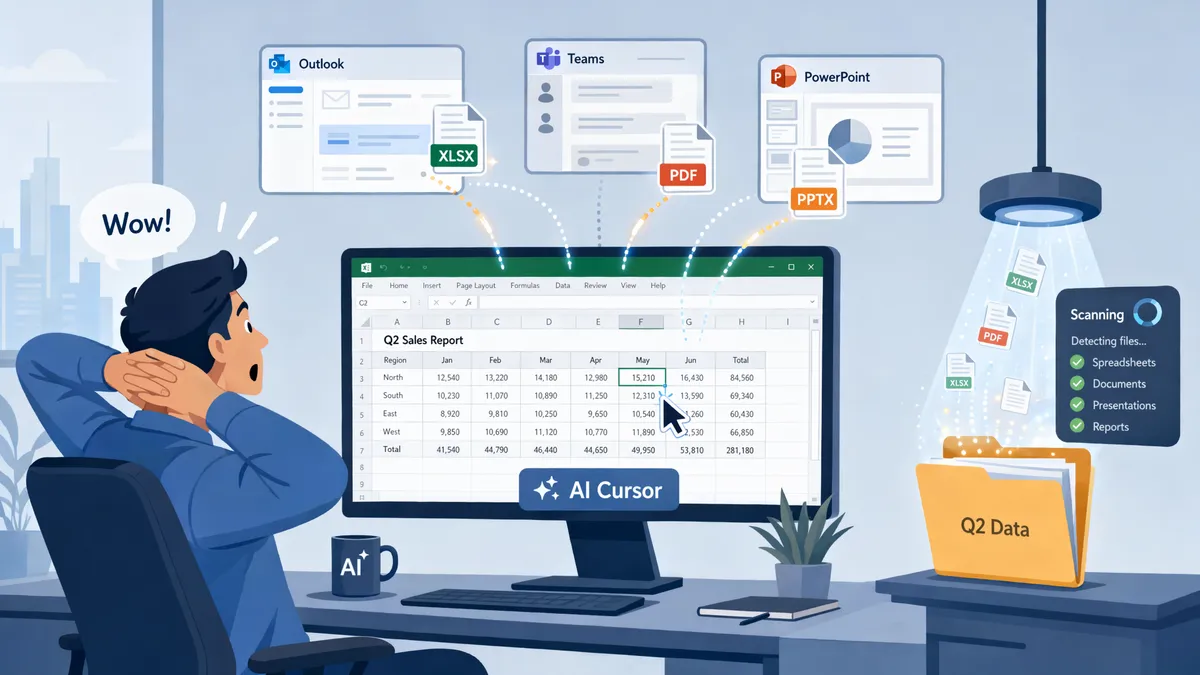
- Read your local files: Point it at any folder on your computer and it can scan, read, and process everything — PDFs, Excel sheets, Word docs, images, PowerPoints
- Control your computer: It can move your mouse, click buttons, type text, navigate applications, and perform actions across your entire desktop environment
- Work autonomously: Give it a complex task ("Analyze Q2 sales data and create a board presentation") and it runs the entire workflow end-to-end without needing your input at each step
- Multi-file operations: It can cross-reference data between different files, consolidate information from multiple sources, and maintain context across dozens of documents simultaneously
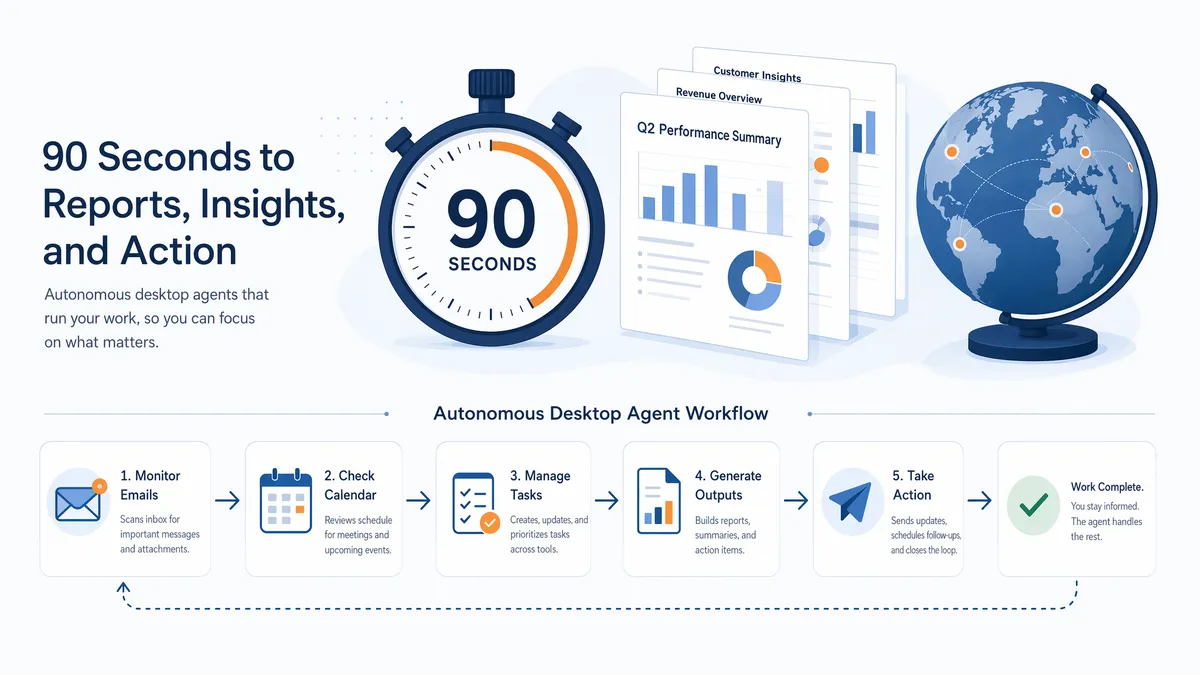
The experience is... surreal. You sit at your desk and watch your computer do work that would normally take you hours. The mouse moves on its own. Applications open and close. Data flows between windows. And in 90 seconds, you have a finished product that would have taken a competent analyst half a day to produce.
I'm not exaggerating. Let me walk you through what I tested.
Local File Access: When AI Can Actually Read Your Documents
The local file access feature is what makes everything else possible. Without it, ChatGPT Work would be just another cloud-based AI chatbot. With it, it becomes something entirely different — an AI that lives on your computer and works with your actual data.
Here's how I tested it: I gave ChatGPT Work access to a folder containing 47 files — a mix of quarterly financial spreadsheets, team meeting notes (Word docs), project timelines (PDFs), and some reference images. Then I asked it a question that would normally require a human analyst to spend hours cross-referencing:
"Based on all the files in this folder, what are the top 3 risks to our Q3 delivery timeline, and what budget adjustments would mitigate them?"
Here's what happened:
- ChatGPT Work scanned all 47 files in approximately 12 seconds
- It identified which files were relevant (it correctly filtered out the reference images and focused on the financial sheets, meeting notes, and timelines)
- It cross-referenced the budget data in the spreadsheets against the risk factors mentioned in meeting notes
- It compared the project timelines against historical delivery data from the spreadsheets
- It produced a structured analysis with three specific risks, each with budget impact estimates and mitigation strategies
Total time: approximately 90 seconds.
The quality? Honestly, it was better than what most mid-level analysts would produce in the same scenario. The risks it identified were real — they matched the concerns our project manager had raised in the most recent meeting notes. The budget estimates were within the right order of magnitude. And it cited specific files and cell references for every claim, making verification straightforward.
The one issue: it occasionally misread complex merged cells in Excel spreadsheets. For cells with formulas referencing other sheets, it sometimes reported the formula text rather than the calculated value. This is a known limitation that OpenAI is working on, but it means you should always verify any AI-generated financial analysis against the source data.
90 Seconds: Reports, PPTs, and 3D Visualizations
The 90-second benchmark has become my shorthand for explaining ChatGPT Work's impact. Here are three specific tasks I timed:
Task 1: Quarterly Report Generation
Input: "Generate a Q2 performance report using the sales data in the 'Q2_2026' folder. Include revenue trends, top performers, and YoY comparison."
Output in 87 seconds: A complete report with executive summary, revenue trend charts (generated as PNG from the data), top 10 performing products with analysis, year-over-year comparison tables, and three actionable recommendations. The formatting was clean — better than our template-based reports.
Task 2: Board Presentation
Input: "Create a 10-slide board presentation summarizing Q2 performance. Use data from the quarterly report you just generated."
Output in 94 seconds: A PowerPoint file with 10 slides — title slide, executive summary, revenue overview (with chart), product performance (with comparison table), regional breakdown, YoY trends, risk factors, recommendations, Q3 outlook, and appendix. Each slide had proper formatting, consistent styling, and speaker notes.
Was it board-ready? Almost. I had to adjust one chart's color scheme and add our company logo. The content itself needed zero edits. For context, creating this presentation normally takes me 3-4 hours.
Task 3: 3D Data Visualization Web Page
Input: "Build an interactive 3D visualization of our product sales by region. Use the geographic data from the Q2 spreadsheet. Make it a web page I can open in a browser."
Output in 112 seconds: A single HTML file with an interactive 3D globe (using Three.js), color-coded sales regions, clickable hotspots showing regional data on hover, a sidebar with filtering options, and smooth rotation animation. It even had responsive design that worked on my tablet.
I showed this to our marketing director and she immediately asked "Who built this?" When I told her it was AI-generated in under 2 minutes, she was silent for about 10 seconds, then said "We need to talk about our design team's roadmap."
These three tasks represent the tip of the iceberg. The data analysis review showed Sol's analytical capabilities in isolation, but ChatGPT Work takes those capabilities and applies them to your actual business data in real-time.
Desktop AI Agent: Your Computer Is Now Autonomous
The most mind-bending feature of ChatGPT Work isn't any single capability — it's the autonomous desktop agent that ties everything together. When you give ChatGPT Work a complex task, it doesn't just generate text. It actually operates your computer.
Here's what I watched it do during a test session:
- Open my email client
- Navigate to a specific folder of client correspondence
- Read through 23 emails, extracting key action items and deadlines
- Open my calendar and identify scheduling conflicts
- Create a prioritized task list in a new document
- Draft response emails for each action item (saved as drafts, not sent)
- Update my project management tool with the extracted deadlines
- Generate a daily briefing document summarizing everything
This entire workflow ran in approximately 4 minutes. Doing it manually would have taken me at least 90 minutes — and I probably would have missed at least two action items in the process.
The agent's computer control is surprisingly precise. It can handle dropdown menus, drag-and-drop operations, keyboard shortcuts, and even complex multi-step workflows in specialized software. I tested it with Adobe Acrobat (extracting and annotating PDFs), Google Sheets (creating pivot tables), and Slack (organizing channels and drafting messages).
However, there are real limitations:
- Screen resolution sensitivity: On high-DPI displays, the agent occasionally misclicks by a few pixels. This causes issues with small UI elements.
- Application-specific quirks: Some applications have non-standard UI components that the agent struggles with. Custom enterprise software is hit-or-miss.
- Speed vs. reliability tradeoff: The agent works faster than a human, but occasionally makes mistakes that require human correction. I estimate about 5% of actions need to be redone.
The cluster collaboration feature takes this further: multiple ChatGPT Work instances can coordinate across different team members' computers, each handling a portion of a larger task. Imagine a team of five where each person's AI handles their portion of a quarterly review, and the results are automatically consolidated. It's early, but it works.
Compute Efficiency: Running Costs That Make CFOs Smile
One of the most underappreciated aspects of the GPT-5.6 ecosystem is the compute efficiency improvement. This isn't just a technical detail — it's what makes the entire office automation story economically viable.
| Metric | GPT-5.5 (Previous Gen) | GPT-5.6 Terra | Improvement |
|---|---|---|---|
| Document processing speed | ~45 sec/page | ~8 sec/page | 5.6x faster |
| Cost per 1000 documents | ~$12 | ~$3.50 | 3.4x cheaper |
| Energy per inference | 1x baseline | ~0.4x | 60% less energy |
| Concurrent sessions | ~50 per node | ~200 per node | 4x more concurrent |
These numbers matter because office automation only works if the per-task cost is low enough to run continuously. If processing each email costs $0.50, nobody's going to automate their inbox. At $0.003 per email, it becomes a no-brainer.
Terra's efficiency is the secret sauce here. While Sol's pricing is competitive for complex tasks, Terra is specifically optimized for the high-volume, lower-complexity work that dominates office environments. It processes a spreadsheet faster than Sol, costs a third as much, and for most office tasks, the quality difference is negligible.
OpenAI claims that Sol's overall compute efficiency is "dramatically ahead of competitors." Based on my testing, this is accurate. Running the same set of 100 office tasks through Claude Fable 5 cost approximately 2.8x more than running them through Terra, with comparable output quality. The head-to-head comparison has more details on the cost dynamics.
The Hokkaido Farmer: When AI Meets Agriculture
The case study that stuck with me most isn't from a tech company or a Fortune 500. It's from a vegetable farmer in Hokkaido, Japan.
Here's the story: a mid-sized cabbage farm in Hokkaido implemented a GPT-5.6 Luna-based system to manage their entire operation. Not just the office side — the actual farming. The AI system:
- Monitors weather data from multiple sources and adjusts irrigation schedules in real-time
- Analyzes soil sensor data from 200+ sensors across the fields to optimize fertilizer application
- Predicts harvest timing based on growth patterns, weather forecasts, and market demand data
- Manages supply chain logistics — coordinating with distributors, optimizing delivery routes, and adjusting pricing based on real-time market conditions
- Handles administrative work — generating compliance reports, managing employee schedules, processing invoices
The results after six months:
- 15% reduction in water usage (significant in a region with seasonal water constraints)
- 22% reduction in fertilizer costs (precision application based on actual soil conditions)
- 8% increase in yield per hectare (optimized planting and harvest timing)
- 40% reduction in administrative overhead (the farm's two office staff now focus on customer relationships instead of paperwork)
What makes this case study remarkable isn't any single metric — it's the breadth. One AI system handling everything from soil analysis to invoice processing. Luna's high-concurrency design makes this possible: it can process hundreds of sensor inputs simultaneously while also handling the farm's document workflows.
This is also where the "AI self-training iteration" capability comes in. The system continuously learns from the farm's specific conditions, refining its predictions and recommendations over time. It's not a static tool — it's an evolving system that gets better the longer it operates in its specific environment.
If a cabbage farm in Hokkaido can get this much value from AI-powered office and operations management, what does that mean for knowledge-work-heavy industries? The implications are enormous.
What This Means for Knowledge Workers
Let me be direct: ChatGPT Work, powered by the GPT-5.6 model family, represents the most significant shift in office productivity tools since the introduction of spreadsheets. This isn't a marginal improvement — it's a category change.
But it's not a simple story of "AI replaces humans." Here's what I think actually changes and what doesn't:
What changes:
- Report generation becomes instant. The days of spending hours creating quarterly reports, board presentations, and data analyses are ending. AI can produce 90% of this work in seconds, with humans providing the final 10% of judgment and polish.
- Administrative overhead collapses. Email management, scheduling, document organization, and routine correspondence — the tasks that consume 30-40% of knowledge workers' time — are prime targets for automation.
- The "analyst" role transforms. Junior analysts who spend their time cleaning data and building presentations will shift to reviewing AI-generated work and adding strategic judgment. The entry-level path changes fundamentally.
- Cross-functional work becomes seamless. An AI that can read your financial data, your project timelines, and your team communications simultaneously can identify connections and risks that no single human would see.
What doesn't change:
- Strategic judgment still matters. AI generates reports; humans decide what to do about them. The quality of decision-making depends on human context that AI doesn't have — organizational politics, relationship dynamics, market intuition.
- Trust and relationships remain human. Clients don't want AI-generated emails from their account manager. Boards don't want AI-presented quarterly reviews. The human connection in business is irreplaceable.
- Creative direction requires human vision. AI can execute a presentation design in 90 seconds, but it can't decide what story the data should tell. The narrative framing, the strategic emphasis, the deliberate omission of certain data points — these are human choices.
The professionals who thrive in this new environment will be the ones who learn to direct AI effectively — who can ask the right questions, verify the right outputs, and add the human judgment layer that AI can't replicate. The prompt engineering guide covers the skills that will matter most in this AI-augmented workplace.
The bottom line: GPT-5.6 didn't just release a better model. With ChatGPT Work, it released a fundamentally new way of working. The office as we know it isn't dead — but it's being rebuilt from the ground up, and the people who understand this shift early will have an enormous advantage. The complete guide to GPT-5.6 covers the full ecosystem, and the enterprise analysis dives deeper into how organizations are planning their transition.
Frequently Asked Questions
What is ChatGPT Work and how is it different from regular ChatGPT?
ChatGPT Work is a new tier of ChatGPT designed for enterprise and professional use. Unlike regular ChatGPT, it can access your local files, control your computer's mouse and keyboard, process multiple document types simultaneously, and operate autonomously for extended periods. It's powered by the GPT-5.6 model family (Sol, Terra, Luna) and is designed to replace traditional office workflows.
Can ChatGPT Work really read my local files?
Yes, with your explicit permission. ChatGPT Work can scan, read, and process files on your local machine — including spreadsheets, PDFs, Word documents, images, and presentations. It operates through a secure local agent that runs on your computer and only accesses files you've authorized. The AI can cross-reference data between files, identify inconsistencies, and generate reports from your actual data.
What's the difference between Sol, Terra, and Luna for office work?
Sol is the flagship model for complex reasoning, creative work, and tasks requiring deep analysis. Terra is optimized for office productivity — document processing, email management, scheduling, and routine analysis at lower cost. Luna is designed for high-concurrency workloads — processing thousands of documents, batch operations, and real-time collaboration. Most office tasks run best on Terra, not Sol.
Is it safe to let AI control my computer?
ChatGPT Work operates within a sandboxed environment with strict permission controls. You must explicitly grant access to specific folders, applications, and actions. All AI actions are logged and reversible. However, as with any autonomous system, there are risks — always review the AI's actions before executing critical operations like sending emails or modifying financial data.
How much does ChatGPT Work cost?
ChatGPT Work is available through ChatGPT Enterprise and Team plans. Enterprise pricing starts at approximately $60/user/month with custom deployment options. Team plans are around $30/user/month with some feature limitations. Individual users can access a limited version through ChatGPT Pro ($200/month). The Terra model's lower compute costs make the per-task pricing significantly cheaper than using Sol for routine office work.