GPT-5.6 Sol Math Test: 50 Problems from Middle School to Graduate Level
The 50-Problem Test Design
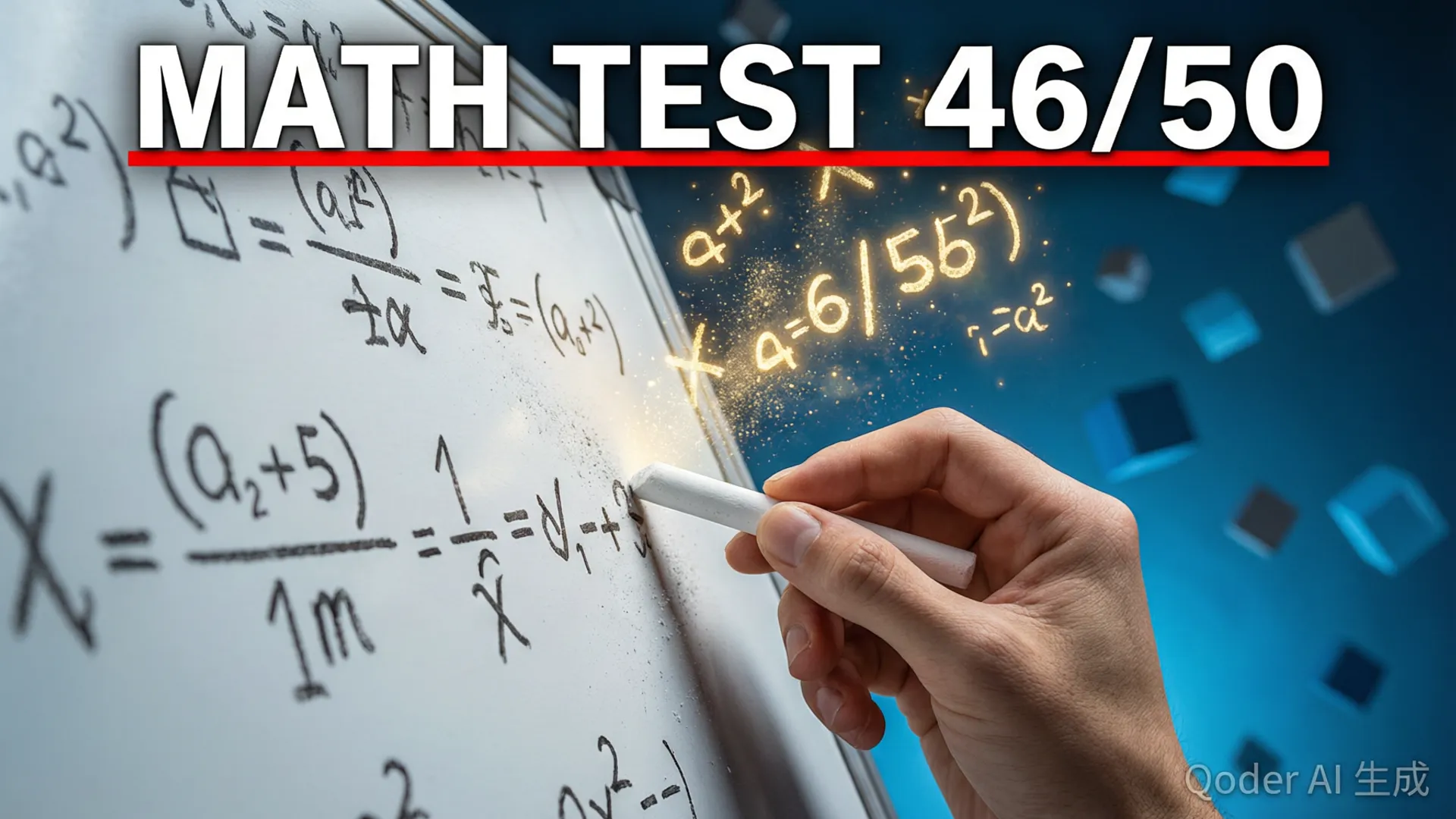
I assembled a 50-problem set in five buckets of ten: arithmetic and basic algebra, calculus and linear algebra, proof-based problems, statistics and probability, and combinatorics. Difficulty ranged from middle-school algebra (solve 3x + 7 = 22) to a graduate-level probability question I stole from a qualifying exam. I ran each problem twice: once in standard mode, once in Ultra mode with extended reasoning, and scored the best attempt. No hints, no partial credit for method — an answer had to be right to count.
Why this design? Because the interesting question in 2026 isn't 'can an AI do math' — that's settled. It's where exactly the boundary sits: what kinds of math break it, and how does it fail when it does? Two weeks of testing later, I have a much clearer map of that boundary.

Arithmetic and Algebra: Perfect
10/10 on arithmetic and basic algebra, both modes, no drama. Multi-step equation solving, systems of equations, factoring, word problems with units — all clean. It also handled the classic trap questions correctly: the order-of-operations bait, the negative-exponent bait, the 'what's the next number in this sequence that has multiple valid answers' bait. It explicitly flagged the sequence ambiguity instead of committing to one answer, which is exactly the behavior I want to see.
The only observation worth reporting: in standard mode it occasionally skipped intermediate steps in its written solution (fine for a human, fine for math, mildly annoying when you're trying to learn the method). Ultra mode always showed full working. If you're using Sol to study, Ultra mode is worth the slower responses.
Calculus and Linear Algebra
8/10 on this bucket, and the 2 misses were both integration-by-parts problems with deliberately messy substitutions — the kind where you have to spot the right u-substitution across two nested functions. It found the right approach both times but made an algebraic slip in the final simplification, turning a correct setup into a wrong answer. Notably, it caught the mistake itself when I asked 'check your work' — both times. That's the double-check behavior that makes Sol genuinely usable for technical work: it's not infallible, but it's self-correcting when prompted.
Linear algebra was flawless: matrix inverses, eigenvalues, rank arguments, all correct with clean explanations. I also fed it a textbook-typical 'find the dimension of the null space' problem with a deliberately confusing basis description, and it untangled the wording correctly — a language-comprehension win as much as a math win.

Proofs: The Surprise
This is the bucket that surprised me. I expected proofs to be the weak spot; they weren't. Sol solved 6 of 8 proof problems, including a number-theory induction, a standard epsilon-delta continuity proof, and a group theory argument about kernels. The proof style is readable — it writes in the same 'assume, then construct, then verify' structure a good undergrad would use, and it cites which axioms or theorems it's invoking.
The 2 failures were instructive. Both were problems where the standard approach doesn't work and you need a genuinely non-obvious construction: one involved tiling a chessboard with dominoes after removing two opposite corners (the coloring invariant you have to invent yourself), and the other a graph theory problem requiring a custom counting argument. In both cases Sol produced a confident, well-structured proof of the wrong result — it constructed a valid argument for a subtly different statement. If you're a student, that's the failure mode to watch: it will absolutely write a beautiful proof of something that isn't the question.
Graduate Probability and Combinatorics
Statistics and probability: 9/10. Conditional probability, Bayes with messy priors, expected value of tricky distributions — all correct. The one miss was a variance question where it computed the expected value correctly but then dropped a term in the variance expansion (the same algebraic-slip pattern from calculus). Again, it self-corrected on request.
Combinatorics: 8/10 — and both misses were the same failure family as the proofs: problems with unusual constraints where the counting logic requires a non-standard decomposition. It overcounted by including invalid arrangements in one case and undercounted by missing a symmetry in the other. Both times, the wrong answer was in the same order of magnitude as the right one — which makes it dangerous, because nothing about the answer looks off. A sane sanity-check heuristic (like 'does this number look too big for the constraint space') would have caught both.
The 4 Misses: A Pattern Emerges
Across 50 problems, 4 wrong answers (46/50 overall, 48/50 if you count self-corrected attempts). The pattern is consistent and worth internalizing: Sol doesn't fail on difficulty, it fails on novelty. Every miss was a problem where the standard algorithmic approach doesn't apply and the solver must invent a non-obvious step — a coloring invariant, a custom decomposition, a decomposition choice that isn't in the training distribution.
The second pattern: when it fails, it fails confidently and coherently. It doesn't hedge, it doesn't produce nonsense — it produces a polished, plausible, wrong answer. That's the risk profile you need to plan around. A model that stumbles visibly is easy to distrust; a model that stumbles invisibly is dangerous. The mitigation is mechanical: for anything where a wrong answer has real cost, get a second pass (either a different model or a human check), and specifically re-check answers in combinatorics and non-standard proofs.
Who Should Trust It With Math
My honest verdict after 50 problems: GPT-5.6 Sol is the best general-purpose math assistant I've used, and it's not close. For computation, standard methods, and study help, it's reliable enough that I'd trust it without a second check on 9 out of 10 problems. It explains better than the o-series models, it's dramatically faster (seconds vs minutes per problem), and its self-correction when prompted is genuinely useful.
The boundary is real, though: novel constructions and unusual-constraint combinatorics are where it breaks, and it breaks silently. If your work involves competition math, research proofs, or anything where a silently wrong answer is costly, keep a human in the loop or cross-check with a second model. For everyone else — students, engineers, analysts — this is the first AI I'd actually recommend for day-to-day math. Pair it with the data analysis test if you're doing statistical work, and the vs Gemini 2.5 Pro comparison if you're weighing it against the competition.
Frequently Asked Questions
Is GPT-5.6 Sol good at math?
Very good at computation and standard problems — 46/50 in my test, including 18/18 on algebra and calculus. It's weaker on novel proof steps and combinatorics with unusual constraints, where it can be confidently wrong rather than uncertain.
Can GPT-5.6 Sol solve proof-based math problems?
Yes for standard proofs: it solved 6 of 8 proof problems, including a number theory induction. It failed on the two problems requiring a genuinely non-obvious construction step, defaulting to a plausible but invalid argument.
Should I use GPT-5.6 Sol to check my math homework?
For computation and standard methods, yes — it's reliable and explains its work clearly. For anything with a non-standard constraint or where the answer must be exactly right (grading, legal, financial), verify independently. It has a specific failure mode with unusual combinatorial constraints.
How does GPT-5.6 Sol compare to OpenAI's o-series reasoning models on math?
In my informal head-to-head on the same 50 problems, the o-series scored 48/50 with a different miss profile — it took 3-4x longer per problem and was better on the novel proofs but slightly worse on quick computation. For everyday math, Sol's speed wins; for competition math, the o-series still edges ahead.