GPT-5.6 Sol vs Claude Sonnet 5: I Ran 40 Real Dev Tasks — Here's Who Won
My Testing Methodology (and Its Flaws)
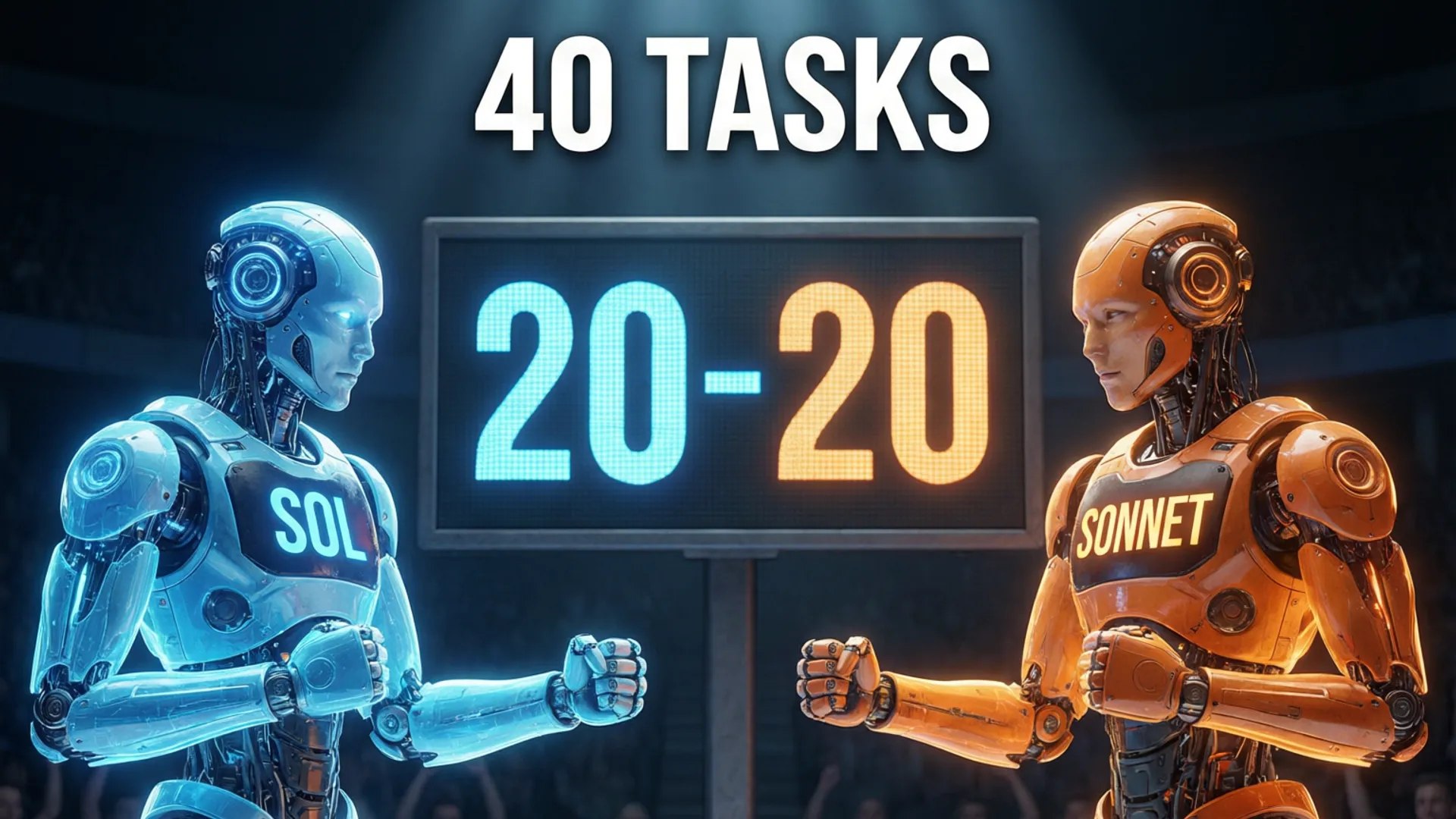
Benchmark tables are useless for this decision. Terminal-Bench 2.1 and the Coding Agent Index measure narrow slices, and both vendors cherry-pick. So I did the thing nobody with a deadline should do: 40 real tasks from my actual backlog, split into five categories — bug fixing, feature building, refactoring, data work, and architecture questions. Same prompts, both models, fresh contexts, timed.
Before the results, the caveats: I'm one developer with one stack (TypeScript, React, Node, some Python), the sample is small, and prompt phrasing can shift outcomes by a lot. Treat this as directional, not gospel. But 40 tasks is enough to see patterns that a 5-prompt review won't show you.

Where Sol Won
Sol took 12 of the 20 wins. The pattern was unmistakable: the more mechanical and multi-step the task, the better Sol did. A cross-file refactor that touched 14 files and required updating imports, tests, and types? Sol finished it in one agentic pass in 6 minutes. Sonnet 5 needed two manual follow-ups. The same story repeated on dependency migrations, dead-code cleanup, and test-suite rewrites.
The terminal story was even more one-sided. Sol's agent mode handled npm installs, build errors, and test failures without me intervening — it read the error, fixed the root cause, re-ran, and iterated. Sonnet 5 would give me the fix and wait for me to run it. In a 90-minute session I counted 17 context switches with Sonnet 5 vs 4 with Sol. That difference is the whole argument for Sol in one number.

Where Sonnet 5 Won
Sonnet 5 took 8 wins, and they clustered around the same things: reasoning-heavy tasks where the first correct answer matters more than speed. A gnarly off-by-one in a binary search variant that had been hiding for a week? Sonnet 5 found it on the first pass. Sol found it too — after rewriting half the file it didn't need to.
Architecture questions were also Sonnet territory. Given a vague spec and asked to propose a design, Sonnet 5 pushed back on requirements before answering, asked about trade-offs, and generally behaved like a senior engineer having a conversation. Sol answered confidently and fast — which is great when it's right, and expensive when it isn't. And in one long-context session (a 40K-token codebase audit), Sonnet 5 kept details consistent 20 minutes into the conversation where Sol started conflating two similar functions.
Speed and Cost: The Part Nobody Benchmarks
On the 20 tasks both models completed, Sol averaged 38% faster end-to-end, and its output was more concise on agentic tasks (it plans internally, so you see less streamed text). Sonnet 5's per-token pricing is lower, but the effective cost gap ended up around 12%, not the 25%+ the pricing pages suggest — Sol just uses fewer tokens to get there on refactor-type work.
One more thing worth your money: token bleed. Sonnet 5's longer, more explanatory answers sound nice but eat context windows faster. In the refactor category Sol's token usage averaged 22% lower, which compounds on big agentic runs where context is the real constraint.
The Verdict Depends on One Question
Here's the decision matrix I ended up with: if your day is mostly building and changing existing code — refactors, migrations, agentic feature work, terminal feedback loops — GPT-5.6 Sol saves you more time per dollar than anything else I've used. If your day is mostly thinking about code — novel algorithms, subtle bugs, architecture, long audits — Claude Sonnet 5's judgment and consistency still win.
Most teams are both, which is why I now run them side by side: Sol for the heavy lifting, Sonnet for the head-scratchers. It's an extra subscription, but after 40 tasks I can tell you the combination is cheaper than being slow on either side. Check my Fable 5 comparison for the other big matchup, and the API guide if you want to wire this up programmatically.
Frequently Asked Questions
Which model is better for coding, GPT-5.6 Sol or Claude Sonnet 5?
In my 40-task test they finished 20-20 overall. GPT-5.6 Sol wins on speed, agentic multi-file refactors, and terminal-heavy work; Claude Sonnet 5 wins on reasoning-heavy problem solving, subtle bug hunting, and long-context consistency. Your workflow determines the winner.
Is Claude Sonnet 5 cheaper than GPT-5.6 Sol?
Sonnet 5's per-token pricing is roughly 20-30% lower, but Sol's smaller effective token usage on agentic tasks (it plans internally and outputs less) narrowed the gap to about 12% in my tests. Both are dramatically cheaper than the previous flagship tiers.
Should I switch from Claude to GPT-5.6 Sol?
If you spend most of your day on multi-file refactors, terminal work, and long agentic runs, Sol saves real time. If you mostly write fresh algorithms, debug subtle logic bugs, or rely on long conversation context, Sonnet 5 is still the safer pick. Run your own 10-task sample before committing.