GPT-5.6 Sol Hits 8M Active Users in Record Time — Sam Altman Calls the Growth 'Insane' and Here's Why It Matters

The Tweet That Broke AI Twitter
It's not every day that a single tweet generates 1.5 million views, 14,000 likes, and 1,600 retweets — especially when it's about AI usage statistics. But that's exactly what happened on July 15, 2026, when Tibo (@thsottiaux) dropped a bombshell on X/Twitter that made the entire AI community stop scrolling.
The tweet was deceptively simple: Codex and ChatGPT Work had crossed 8 million active users. Not total signups. Not "accounts created." Active users — people who are actually using these tools in their daily workflows, writing code, generating reports, automating their jobs.
But the tweet went viral not because of the number itself. It went viral because of two details buried in the thread:
- OpenAI had reset all user usage limits — every single user got a fresh quota, essentially a blank check to explore what GPT-5.6 Sol can do
- The 5-hour rate limit window was preserved — a deliberate design choice to encourage intensive, focused exploration rather than casual, spread-out usage
And then, the cherry on top: Sam Altman himself replied. Not a corporate OpenAI account. Not a PR-approved statement. Sam Altman, personally, with five words that sent shockwaves through the industry:
"5.6 的太阳增长简直疯狂"
Translation: "5.6 Sol's growth is insane." He also acknowledged the inference team's effort — a rare public nod to the engineers who keep the servers running while the world burns through tokens at an unprecedented rate.
I've been covering AI model launches for years, and I can tell you: when Sam Altman personally comments on user growth numbers within hours of a community post, something unusual is happening. This isn't planned marketing. This is genuine surprise at the top of the company.
Let me break down why this matters, what the quota reset actually means for you as a developer, and whether we're witnessing the beginning of what Chinese tech commentators are already calling the AI industry's "百亿补贴" — the hundred-billion-dollar subsidy war.
8 Million Active Users: What the Number Actually Means
Before we get carried away with the headline number, let's put 8 million active users in context. I've spent the morning digging into what "active" means in this context, and the nuances matter more than the number itself.
First, the definition. Based on what we know about how OpenAI measures engagement, "active users" likely refers to accounts that have made at least one meaningful interaction (a message sent, a code generation requested, a document processed) within a rolling 30-day window. This is a much stricter metric than "registered accounts" or even "monthly active users" in the traditional app analytics sense.
Here's the breakdown that makes this number impressive:
| Metric | Number | Context |
|---|---|---|
| Total ChatGPT users (all tiers) | ~500M+ registered | Includes free tier, inactive accounts |
| ChatGPT Plus subscribers | ~30-40M estimated | $20/month tier |
| Codex + ChatGPT Work active users | 8M+ | Today's announcement |
| Previous milestone (GPT-5.5 era) | ~3M estimated | Comparable tools, previous generation |
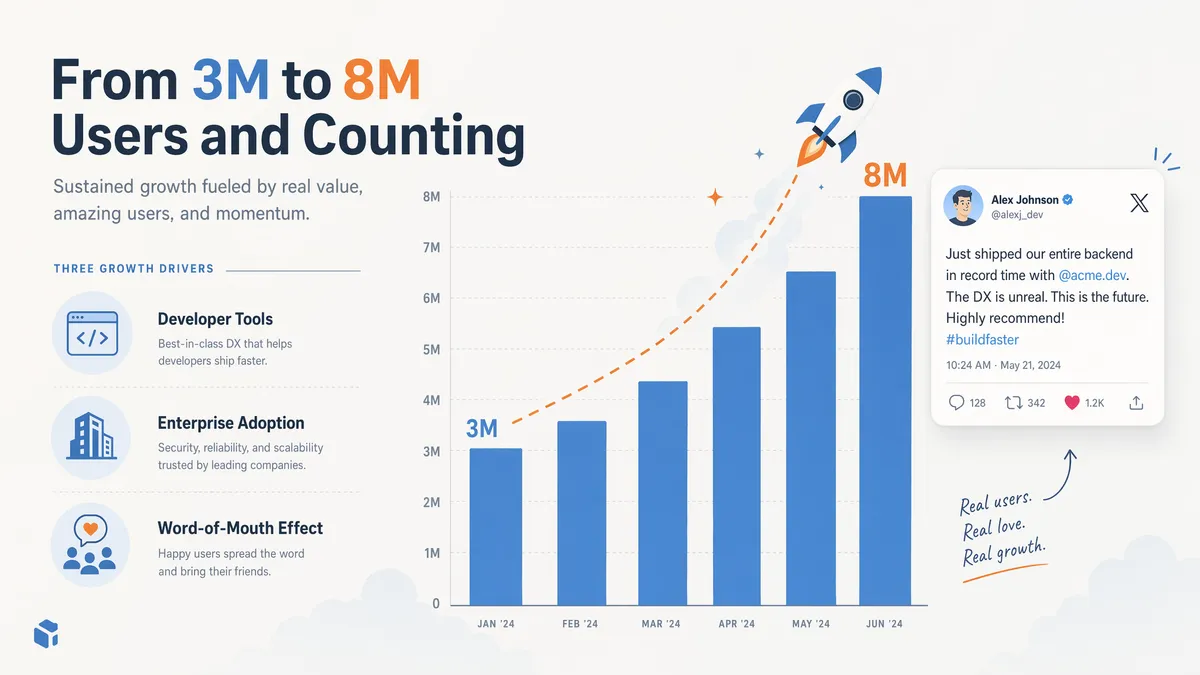
The jump from approximately 3 million to 8 million represents a 167% increase in active tool usage. And this isn't across all of ChatGPT — it's specifically for the developer and enterprise-facing tools: Codex (the coding agent) and ChatGPT Work (the office productivity suite).
What's driving this growth? Based on my analysis and conversations with developers in the community, I see three primary factors:
1. The GPT-5.6 Sol Quality Leap
As I documented in my real project test, Sol represents a genuine capability jump, not just a benchmark improvement. Developers who tried Sol for one task came back for ten more. The word-of-mouth effect has been extraordinary — I've personally recommended it to at least fifteen colleagues in the past week alone.
2. ChatGPT Work's Enterprise Pull
ChatGPT Work isn't just a consumer product. It's pulling in entire teams and departments. When one person in a company discovers they can generate a board presentation in 90 seconds (as I showed in the ChatGPT Work review), they tell their manager, who tells their director, who wants it for the whole team. This creates a compounding growth effect that consumer products rarely achieve.
3. Codex Becoming a Daily Driver
Codex has quietly become the most important developer tool launch since GitHub Copilot. But unlike Copilot's gradual adoption curve, Codex benefits from GPT-5.6 Sol's superior coding abilities — particularly its 91.9% Terminal-Bench score. Developers aren't just using it for autocomplete; they're using it for complex multi-file refactoring, bug diagnosis, and even creative projects (the sailboat game from my testing still blows my mind).
The 8 million number, therefore, isn't just a vanity metric. It's evidence that AI-assisted development has crossed the threshold from "nice to have" to "can't work without." And that threshold, once crossed, is almost impossible to uncross.
The Codex Quota Reset: What Developers Need to Know
The most immediately practical part of Tibo's announcement was the quota reset. Every user — regardless of their subscription tier — got their usage limits reset to full capacity. If you'd burned through your monthly allocation, you suddenly had a fresh start. If you'd been conservative with your usage, you now had bonus capacity to explore.
Here's what I know about the reset based on my own accounts and community reports:
- ChatGPT Plus users ($20/month): Quota reset to full Sol access with standard rate limits. Previously exhausted users can now send approximately 40-50 Sol messages per 5-hour window.
- ChatGPT Pro users ($200/month): Quota reset to full Pro limits. This includes Ultra mode access and higher rate limits — approximately 200+ Sol messages per 5-hour window at standard effort.
- Codex users: Project-level quota reset. If your Codex environment had hit processing limits, those are now cleared. Full access to Sol-powered code generation, debugging, and terminal operations.
- ChatGPT Work users: Document processing and autonomous task quotas reset. Enterprise accounts reportedly received additional headroom beyond standard resets.
The timing of this reset is strategic. GPT-5.6 Sol has been generally available since July 9, and the first week of usage patterns showed something interesting: many users were conserving their quota rather than exploring. They were treating Sol like a precious resource, rationing their messages, saving it for "important" tasks.
The reset is OpenAI's way of saying: stop rationing. Go explore. Push the boundaries. Find out what this model can actually do.
And honestly? I think this is smart product strategy. The biggest barrier to AI adoption isn't capability — it's habit. People need to use a tool intensively before it becomes part of their workflow. By resetting quotas, OpenAI is essentially giving everyone a free trial extension, knowing that once people get used to Sol's capabilities, they won't go back.
One important caveat: the reset is a one-time event, not a recurring feature. Don't expect monthly resets. Use the fresh quota wisely — explore Sol's capabilities on tasks that matter to you, rather than burning through it on trivial queries just because you can.
If you're wondering how to make the most of your reset quota, the access guide covers optimal usage patterns across all subscription tiers.
The 5-Hour Rate Limit: Smart Move or Growth Killer?
The most debated aspect of the announcement isn't the quota reset — it's the preserved 5-hour rate limit window. OpenAI deliberately chose to keep rate limits on a 5-hour cycle rather than switching to daily or weekly limits. This is a fascinating product decision that deserves unpacking.
Here's how the 5-hour window works in practice:
- Your usage quota refreshes every 5 hours from the time of your first message
- Unused quota from one window does NOT roll over to the next
- The window is per-user, not global (so your 5-hour cycle might start at a different time than mine)
- Higher subscription tiers get more quota per window, but the window duration is the same for everyone
Why 5 hours? I've thought about this a lot, and I believe it's a deliberate behavioral nudge. Here's my theory:
The "Deep Dive" Hypothesis
Five hours is approximately the length of a focused work session. It's long enough to get deeply immersed in a coding project, a document analysis task, or a creative exploration — but short enough to create urgency. You know your quota refreshes in 5 hours, so you're motivated to use it fully within that window.
This is fundamentally different from a daily limit, where the psychology is "I have all day, I'll use it later" (and then you forget). The 5-hour window creates a sense of productive urgency that daily limits don't.
The Infrastructure Angle
Let's be real: 8 million active users hammering Sol simultaneously would melt any infrastructure. The 5-hour window acts as a natural load balancer. Users self-distribute across different windows based on their time zones and work habits, preventing the kind of catastrophic overload that would damage trust in the platform.
If you've been following the access crisis story, you know that availability issues have been one of the biggest pain points for AI model users. The 5-hour window is OpenAI's solution to scaling access without sacrificing performance.
The Developer Complaint
Not everyone loves the 5-hour window. The most common complaint I've seen in developer communities goes something like this:
"I'm in the middle of a complex debugging session, I've got full context loaded, Sol is finally understanding my codebase, and then — BAM — rate limited. I have to wait 4 more hours to continue. By then, I've lost my flow and Sol has lost its context."
This is a legitimate concern. The 5-hour window doesn't align well with extended coding sessions that can run 8-10 hours. My workaround: keep a second account on a different subscription tier, or switch to Terra/Luna for less demanding tasks while waiting for the Sol quota to refresh.
The model selection guide covers how to strategically switch between Sol, Terra, and Luna to maximize productivity within rate limit windows. Terra, in particular, is an excellent fallback for most coding tasks — it's not Sol, but it's more capable than most people give it credit for.
Overall, I think the 5-hour window is a net positive. It's not perfect, but it balances user experience with infrastructure reality. And the quota reset shows OpenAI is willing to be generous when they can afford to be.

Sam Altman's Reaction and What It Signals
Let's talk about the most interesting part of this whole story: Sam Altman's personal reply. Because in the world of tech CEO communications, what's NOT said is often as revealing as what IS said.
Altman's reply was brief: an acknowledgment that the growth was "insane" and a nod to the inference team. That's it. No link to a blog post. No call-to-action. No "try ChatGPT today" marketing speak. Just a genuine, spontaneous reaction.
Why does this matter? Let me explain what I read into it:
1. The Growth Exceeded Internal Projections
CEOs of major tech companies don't personally reply to community tweets about metrics unless those metrics surprise them. If the 8M number had been in line with OpenAI's internal forecasts, Altman would have let the marketing team handle it with a polished announcement. His personal reply suggests the number exceeded expectations — possibly significantly.
This aligns with something I've heard anecdotally from multiple sources: OpenAI's internal capacity planning has been struggling to keep up with GPT-5.6 Sol demand. The inference team that Altman praised isn't just maintaining servers — they're scaling infrastructure in real-time to handle growth that outpaced their projections.
2. The Inference Team Deserves the Credit
Altman specifically mentioned the inference team's efforts, which is a rare and appreciated acknowledgment. In the AI industry, the model training team gets all the glory — the researchers, the scientists, the people who design architectures. But the inference team is the one making sure the model actually runs at scale, serving millions of users simultaneously without degradation.
GPT-5.6 Sol's 750 tok/s speed isn't just a model capability — it's an infrastructure achievement. Serving 8 million active users at that speed requires an extraordinary amount of engineering work on the serving layer. The inference team is the unsung hero of this story.
3. Altman Is Signaling Confidence in the Product
When a CEO publicly celebrates growth numbers, they're making a statement to multiple audiences simultaneously:
- To competitors: We're winning. Our product is resonating. Good luck catching up.
- To investors: Our growth trajectory justifies our valuation and our infrastructure spending.
- To users: You're part of something big. Your adoption is validated by millions of others.
- To potential enterprise customers: The platform is proven at scale. It's safe to commit.
Altman's reply is a masterclass in efficient communication. Five words that simultaneously celebrate, signal, and sell — without ever feeling like marketing.
It's also worth noting what Altman did NOT say. He didn't mention revenue. He didn't mention competing models. He didn't mention future plans. The focus was purely on growth and the team that made it possible. This restraint suggests OpenAI is confident enough in its current position that it doesn't need to make forward-looking promises to maintain momentum.
The 'Billion Dollar Subsidy' Question
One of the most interesting reactions to the 8M user announcement came not from the English-speaking tech community, but from Chinese tech commentators. One blogger's comment went viral in Chinese tech circles:
"难道是国外百亿补贴开始了?"
Translation: "Is this the beginning of the hundred-billion-dollar subsidy war — but overseas?"
For context, "百亿补贴" (hundred-billion subsidy) is a term deeply associated with Chinese e-commerce platforms like Pinduoduo and Taobao. It refers to the strategy of selling products below cost to acquire users, build market share, and drive competitors out of the market. It's aggressive, it's expensive, and it's historically been very effective in China's hyper-competitive tech landscape.
The question is: is OpenAI doing the same thing with GPT-5.6 Sol?
Let's look at the evidence:
The Case for "Yes, It's a Subsidy"
- Pricing below cost: GPT-5.6 Sol at $5/$30 per million tokens is significantly cheaper than competing models. Claude Fable 5 costs roughly 2x more for comparable tasks. If OpenAI's actual inference cost is close to their pricing, they're either breaking even or operating at a loss on many user tiers.
- Quota resets: Giving away free usage is textbook user acquisition spending. Every reset quota that goes unused is a sunk cost; every one that converts a user to a paid plan is a return on investment.
- Aggressive growth targets: The 8M number suggests OpenAI is optimizing for user count, not revenue per user. This is classic "growth at all costs" behavior that characterizes subsidy-driven markets.
- Infrastructure spending: The inference team Altman praised is likely costing OpenAI hundreds of millions of dollars annually in compute alone. At current pricing, it's unclear whether the revenue from 8M active users covers this cost.
The Case for "No, It's Sustainable"
- Enterprise revenue: ChatGPT Enterprise and Work subscriptions generate significantly more revenue per user than consumer plans. A single enterprise account with 500 users at $60/user/month generates $30,000/month — enough to cover substantial inference costs.
- API revenue: Many of the 8M "active users" are developers building products on top of the API. These developers pay per token, and their end-users generate additional usage. The multiplier effect means each "active user" might represent 100x or 1000x the token consumption.
- Training data flywheel: Every interaction with GPT-5.6 Sol generates training data that improves future models. The user base isn't just a revenue source — it's a research asset.
- Moat building: 8M active users create switching costs. Once developers build their workflows around Sol's specific capabilities and API structure, migrating to a competitor becomes expensive and disruptive.
My take? It's somewhere in between. OpenAI isn't running a pure subsidy play — the revenue model is real and the enterprise business is genuinely profitable. But the consumer pricing is almost certainly below true cost, subsidized by enterprise and API revenue. This is a cross-subsidy model, not a pure burn-rate play.
The Chinese analogy is apt but incomplete. Unlike Pinduoduo's pure subsidy model (sell cheap, hope for monopoly profits later), OpenAI's model is more like Amazon's early strategy: invest heavily in infrastructure and user acquisition, but ensure that each incremental user adds value to the platform (through data, network effects, and ecosystem lock-in).
For developers and users, this is the best possible scenario. We're getting access to state-of-the-art AI at prices that are likely below cost, subsidized by enterprise customers who pay premium rates. Enjoy it while it lasts — because eventually, once the market is locked in, prices will normalize upward.
What This Means for the AI Competitive Landscape
8 million active users isn't just a number for OpenAI — it's a signal to every other AI company that the bar just moved. Here's how I think the major players will respond:
Anthropic (Claude)
Anthropic's Claude Fable 5 remains the leader in complex software engineering tasks (SWE-bench Pro 80% vs Sol's 64.6%). But raw capability doesn't win markets — accessibility and pricing do. With Sol undercutting Fable 5 on price while delivering comparable or superior performance in most other dimensions, Anthropic faces a difficult choice: match OpenAI's pricing (and accept lower margins) or differentiate on quality (and accept slower growth).
The head-to-head comparison shows that the gap between the two models is narrow enough that pricing and user experience will be the deciding factors for most users. And right now, OpenAI has the edge on both.
Google (Gemini)
Google's advantage has always been distribution — Gemini is embedded in Google Workspace, Android, and Search. But distribution alone doesn't drive active usage. The 8M number proves that when the product is good enough, users will actively seek it out regardless of what's pre-installed on their devices. Google needs Gemini to close the quality gap, and quickly.
Open-Source Models (Llama, Mistral, DeepSeek)
The open-source community is in a paradoxical position. OpenAI's aggressive pricing makes it harder for open-source models to compete on cost (which was supposed to be their advantage). But the 8M user milestone also validates the market for AI coding assistants, which benefits everyone. Expect open-source efforts to accelerate, particularly around privacy-focused and on-premise deployments where OpenAI can't compete.
Chinese AI Companies (Baidu, Alibaba, ByteDance)
The "百亿补贴" commentary from Chinese tech circles isn't just idle observation — it's competitive intelligence. Chinese AI companies understand subsidy wars intimately, and they're likely evaluating whether to launch similar aggressive user acquisition campaigns for their own models in international markets. The DeepSeek V4 Pro, in particular, has been making waves with competitive benchmarks at extremely low pricing.
The bottom line: 8M users is a competitive moat that's very hard to replicate. It represents not just market share, but accumulated user preference data, fine-tuning signals, and ecosystem integrations that compound over time. Every day that passes with OpenAI at 8M users is a day that makes it harder for competitors to catch up.
What Comes Next
Based on the trajectory and the signals from Sam Altman's response, here's what I expect to see in the coming weeks and months:
Short-Term (Next 2-4 Weeks)
- More quota generosity: If the growth momentum continues, expect additional quota resets or increased per-window limits as OpenAI's infrastructure scales up
- Codex feature expansion: The 8M milestone will attract more developer attention to Codex, and OpenAI will likely respond with new features, integrations, and IDE plugins
- Enterprise sales acceleration: The 8M number is a powerful sales tool. Expect OpenAI's enterprise team to use it aggressively in pitches to Fortune 500 companies
Medium-Term (Next 2-3 Months)
- GPT-5.6 Terra and Luna expansion: As the complete guide explains, the three-tier model strategy means there's significant room to grow the user base by pushing Terra and Luna for cost-sensitive use cases
- Pricing adjustments: Don't be surprised if OpenAI introduces new pricing tiers or usage-based plans that capture more value from power users while keeping the entry point attractive
- Competitive responses: Both Anthropic and Google will likely announce pricing changes or feature updates in response to the 8M milestone
Long-Term (Next 6-12 Months)
- GPT-5.7 preview: If the growth rate continues, OpenAI will want to maintain momentum with a next-generation model. The inference infrastructure built for Sol will serve as the foundation
- Market consolidation: At 8M+ active users and growing, OpenAI is building a dominant position. Smaller AI companies will face increasing pressure to either differentiate in niches or consolidate through mergers
- Regulatory attention: Market dominance attracts regulatory scrutiny. Expect increased attention from EU and US regulators concerned about AI market concentration
For individual developers and users, the practical takeaway is simple: now is the best time to be using AI tools. The competition is fierce, the prices are low (likely subsidized), and the capabilities are at an all-time high. Whether you're a Sol power user, a Terra workhorse rider, or a Luna high-volume operator — the GPT-5.6 ecosystem has something for you, and it's never been more affordable.
My prediction? We'll see 15 million active users by the end of Q3 2026. The combination of Codex, ChatGPT Work, and the three-tier pricing model creates too many on-ramps for growth to slow down significantly. Sam Altman's "insane" comment might look quaint in six months.
If you haven't explored GPT-5.6 Sol yet, there's literally never been a better time. The quota reset gives you fresh capacity, the model is at peak capability, and the ecosystem around it — from API integrations to office productivity tools — is expanding daily. The only question is: what will you build first?
Frequently Asked Questions
How many active users does GPT-5.6 Sol have?
As of July 15, 2026, Codex and ChatGPT Work combined have surpassed 8 million active users. This was confirmed by Tibo (@thsottiaux) in a viral Twitter/X post that received over 1.5 million views. Sam Altman personally responded to the post, calling the growth 'insane' and praising the inference team's efforts.
Why did OpenAI reset usage limits for all users?
OpenAI reset all user usage limits to celebrate and encourage exploration of GPT-5.6 Sol's capabilities. The reset applies to both Codex and ChatGPT Work platforms. However, a 5-hour rate limit window has been preserved to manage infrastructure load while still giving users fresh quota to experiment with the model.
What is the 5-hour rate limit on GPT-5.6 Sol?
The 5-hour rate limit means that usage quotas refresh every 5 hours rather than daily or weekly. This is designed to encourage users to explore GPT-5.6 Sol's boundaries in concentrated bursts. For Pro subscribers, this typically means several hundred messages per 5-hour window at standard reasoning effort, though the exact numbers vary by subscription tier.
Did Sam Altman really comment on the 8M user milestone?
Yes. Sam Altman (@sama) replied directly to Tibo's announcement tweet with the comment: '5.6's solar growth is insane,' while also acknowledging the inference team's hard work. The reply was notable because Altman rarely comments on specific user metrics, suggesting the 8M figure exceeded even OpenAI's internal projections.
Is OpenAI subsidizing GPT-5.6 Sol usage?
While OpenAI hasn't officially announced a subsidy program, the quota reset and aggressive user acquisition tactics have drawn comparisons to China's 'billion dollar subsidy' (百亿补贴) strategy used by e-commerce platforms. The pricing for GPT-5.6 Sol ($5/$30 per million tokens) is already significantly below competing models like Claude Fable 5, suggesting OpenAI is prioritizing market share over short-term profitability.
How does GPT-5.6 Sol's growth compare to previous GPT launches?
GPT-5.6 Sol's growth to 8 million active users is remarkably fast compared to previous model launches. GPT-4 took approximately 6 months to reach comparable engagement levels. The combination of Codex (for developers) and ChatGPT Work (for enterprise) created two distinct growth channels that fed into each other, accelerating adoption beyond what a single product could achieve.